HISTORY OF MATHEMATICS
The area of study known as the history of mathematics is primarily an investigation into the origin of discoveries in mathematics and, to a lesser extent, an investigation into the mathematical methods and notation of the past.
 Before the modern age and the worldwide spread of knowledge, written examples of new mathematical developments have come to light only in a few locales. The most ancient mathematical texts available are Plimpton 322 (Babylonian c. 1900 BC),the Rhind Mathematical Papyrus (Egyptian c. 2000–1800 BC) and the Moscow Mathematical Papyrus (Egyptian c. 1890 BC). All of these texts concern the so-called Pythagorean theorem, which seems to be the most ancient and widespread mathematical development after basic arithmetic and geometry.
The study of mathematics as a demonstrative discipline begins in the 6th century BC with the Pythagoreans, who coined the term "mathematics" from the ancient Greek μάθημα (mathema), meaning "subject of instruction".Greek mathematics greatly refined the methods (especially through the introduction of deductive reasoning and mathematical rigor in proofs) and expanded the subject matter of mathematics. Chinese mathematics made early contributions, including a place value system. The Hindu–Arabic numeral system and the rules for the use of its operations, in use throughout the world today, likely evolved over the course of the first millennium AD in India and were transmitted to the west via Islamic mathematics through the work of Muḥammad ibn Mūsā al-Khwārizmī. Islamic mathematics, in turn, developed and expanded the mathematics known to these civilizations. Many Greek and Arabic texts on mathematics were then translated into Latin, which led to further development of mathematics in medieval Europe.
From ancient times through the Middle Ages, periods of mathematical discovery were often followed by centuries of stagnation. Beginning in Renaissance Italy in the 16th century, new mathematical developments, interacting with new scientific discoveries, were made at an increasing pace that continues through the present day.

What is mathematics
Mathematics is an old, broad, and deep discipline (field of study). People working to improve math education need to understand "What is Mathematics?" |  |
A Tidbit of History
Mathematics as a formal area of teaching and learning was developed about 5,000 years ago by the Sumerians. They did this at the same time as they developed reading and writing. However, the roots of mathematics go back much more than 5,000 years.
Throughout their history, humans have faced the need to measure and communicate about time, quantity, and distance. The Ishango Bone is a bone tool handle approximately 20,000 years old.

Figure 1
The picture given below shows Sumerian clay tokens whose use began about 11,000 years ago . Such clay tokens were a predecessor to reading, writing, and mathematics.

Figure 2
The development of reading, writing, and formal mathematics 5,000 years ago allowed the codification of math knowledge, formal instruction in mathematics, and began a steady accumulation of mathematical knowledge.
Beauty in Mathematics

Relatively few K-12 teachers study enough mathematics so that they understand and appreciate the breadth, depth, complexity, and beauty of the discipline. Mathematicians often talk about the beauty of a particular proof or mathematical result. Do you remember any of your K-12 math teachers ever talking about the beauty of mathematics?
G. H. Hardy was one of the world's leading mathematicians in the first half of the 20th century. In his book "A Mathematician's Apology" he elaborates at length on differences between pure and applied mathematics. He discusses two examples of (beautiful) pure math problems. These are problems that some middle school and high school students might well solve, but are quite different than the types of mathematics addressed in our current K-12 curriculum. Both of these problems were solved more than 2,000 years ago and are representative of what mathematicians do.
- A rational number is one that can be expressed as a fraction of two integers. Prove that the square root of 2 is not a rational number. Note that the square root of 2 arises in a natural manner as one uses land-surveying and carpentering techniques.
- A prime number is a positive integer greater than 1 whose only positive integer divisors are itself and 1. Prove that there are an infinite number of prime numbers. In recent years, very large prime numbers have emerged as being quite useful in encryption of electronic messages.
Problem Solving
The following diagram can be used to discuss representing and solving applied math problems at the K-12 level. This diagram is especially useful in discussions of the current K-12 mathematics curriculum.

Figure 3
The six steps illustrated are 1) Problem posing; 2) Mathematical modeling; 3) Using a computational or algorithmic procedure to solve a computational or algorithmic math problem; 4) Mathematical "unmodeling"; 5) Thinking about the results to see if the Clearly-defined Problem has been solved,; and 6) Thinking about whether the original Problem Situation has been resolved. Steps 5 and 6 also involve thinking about related problems and problem situations that one might want to address or that are created by the process or attempting to solve the original Clearly-defined Problem or resolve the original Problem Situation.
WHERE CAN WE FIND MATH
When you buy a car, follow a recipe,r decorate your home, you're using math principles. People have been using these same principles for thousands of years, across countries and continents. Whether you're sailing a boat off the coast of Japan or building a house in Peru, you're using math to get things done.
How can math be so universal? First, human beings didn't invent math concepts; we discovered them. Also, the language of math is numbers, not English or German or Russian. If we are well versed in this language of numbers, it can help us make important decisions and
perform everyday tasks. Math can help us to shop wisely, buy the right insurance, remodel a home within a budget, understand population growth, or even bet on the horse with the best chance of winning the jackpot
| ||
What Math Skills Are Needed to Become an Engineer?
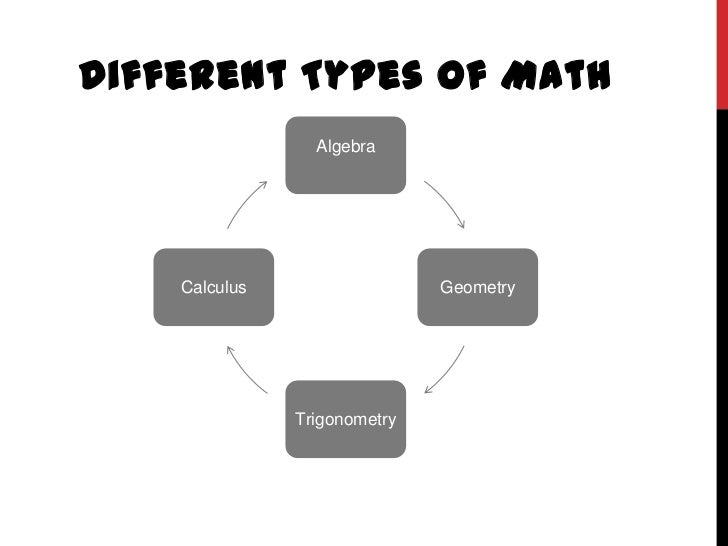
Basic Arithmetic
All math is based on the idea that 1 plus 1 equals 2, and 1 minus 1 equals 0. Multiplication and division --2 times 2 and 4 divided by 2 -- are variations used to avoid multiple iterations of either subtraction or addition. One example of an engineer's use of basic arithmetic is the civil engineer's calculations for describing water flow across an open basin. The flow is reckoned in cubic feet per second, or Q, where Q equals the runoff coefficient times the intensity of the rain for a specified period, times the area of the basin. If the runoff coefficient is 2, the intensity, in inches of rain, is 4 and the basin -- a specified area of land -- is 1/2 acre, the engineer's formula resembles this: (2x4)/(.5x43,560), or 8/21,780. The result, 0.0003673, is the volume of water, in cubic feet per second, flowing across the land.
Algebra and Geometry
When several of the factors of a problem are known and one or more are unknown, engineers use algebra, including differential equations in cases when there are several unknowns. Because engineers work to arrive at a solution to a physical problem, geometry -- with its planes, circles and angles -- determines such diverse things as the torque used to turn a wheel, and reduces the design of a roadway's curve to an accurate engineering or construction drawing.
Trigonometry
Trigonometry is the science of measuring triangles. Engineers may use plane trigonometry to determine the size of an irregularly shaped parcel of land. It may also be used or to determine the height of an object based solely on the distance to the object and the angle, up or down, from the observer. Spherical trigonometry is used by naval engineers in ship design and by mechanical engineers working on such arcane projects as the design of mechanical hand for an underwater robot.
Statistics
We all love statistics. They tell us where we stand in the world, among our peers and even in our family. They tell us who's winning. The engineer uses them for the same reasons -- by statistical analysis of the design, the engineer can tell what percentage of a design will need armor or reinforcement or where any likely failures will occur. For the civil engineer, statistics appear as the concentration of rainfall, wind loads and bridge design. In many locations, engineers designing drainage systems must design for a 50- or 100-year storm in their calculations, a significant change from the normal rain concentration.
Calculus
Calculus is used by engineers to determine rates of change or rates by which factors, such as acceleration or weight, change. It might tell NASA scientists at what point the change in a satellite's orbit will cause the satellite to strike an object in space. A more mundane task for calculus might be determining how large a box must be to accommodate a specific number of things. An engineer who designs packaging, for example, might know that a product of a certain weight must be packaged in groups of no more than 10 because of their weight. Using calculus, he can calculate both the optimum number of objects per box, plus the optimum size of the box.
THANK YOU FOR READING

